

Peptides for skin are short chains of amino acids that act as messengers, telling your skin to make more of its own collagen and elastin. Used consistently for eight to twelve weeks, they help skin look firmer, smoother and more rested. They will not deliver drama overnight. What they deliver is quieter and far more interesting: skin that starts behaving like a better version of itself.
You probably know the moment. The crease from your pillow lingers past your second coffee. Concealer settles into a line that was not there last spring. Your skin still looks like you, just a little less sprung. None of it is dramatic, which is exactly why it is easy to ignore and exactly why peptides deserve a place in your routine now rather than later.
Why skin loses its bounce
Collagen is the scaffolding. Elastin is the snap back. Together they are why young skin rebounds when you press it and why a laugh line disappears the second you stop laughing.
From our mid twenties, the skin gradually makes less of both. Then life adds its own edits. UV exposure breaks collagen down faster than we rebuild it, and in Ireland that includes the grey days, because UVA passes straight through cloud. Pollution, poor sleep and stress pile on. So does glycation, which is when sugar molecules bind to collagen fibres and leave them stiff and brittle.
The result is not one big change. It is a slow softening of the jawline, lines that stay a little longer each year and a texture that looks less plump under light. That is the concern peptides are built for.
What are peptides in skincare?
Peptides are fragments of protein. Your skin reads certain fragments as a sign that collagen has been broken down and needs replacing, so applying them topically nudges it to repair and rebuild. Crucially, they are not adding collagen to your face. They are asking your skin to make more of its own.
Peptides are a family rather than a single ingredient, and each branch has a different job. Here is the short version:
Signal peptides: These send a message to fibroblasts, the cells that produce collagen, to step up production. Palmitoyl pentapeptide 4, sold under the name Matrixyl, is the most widely studied example.
Best for: fine lines and overall firmness.
Carrier peptides: These deliver trace minerals into the skin to support repair. Copper tripeptide 1, often listed as GHK Cu, is the headline act, with research linking it to collagen support, wound healing and a calmer, stronger barrier.
Best for: repair, resilience and thinning skin.
Neurotransmitter inhibiting peptides: These soften the repeated muscle contractions that etch expression lines over time. Acetyl hexapeptide 8, known as Argireline, is the best known. It is a softening effect, not a freeze, so your face still moves like your face.
Best for: forehead lines, frown lines and crow's feet.
Enzyme inhibitor peptides: These slow the enzymes that break collagen down in the first place. Often derived from soy or rice, they are the least talked about and quietly useful in formulas aimed at density and firmness.
Best for: long term prevention.

What peptides can do for your skin, and what they cannot
Let us be precise, because this is where most peptide marketing loses the plot.
What they do well: visible improvement in firmness and elasticity, a softer look to fine lines, better hydration and a stronger skin barrier. Many peptides also have a natural affinity for water, so skin often feels more cushioned within a couple of weeks, long before the collagen work shows.
What they will not do: replace injectables, lift significant sagging or undo years of sun damage in a month. Anyone promising that is selling something.
Why they earn their place anyway: tolerance. Peptides do not cause the flaking, stinging or sun sensitivity that can come with retinoids and acids. They suit almost every skin type, including sensitive and reactive skin, and they layer well with nearly everything else on your shelf. In results driven skincare, an active you will use every single day beats a stronger one that lives in your drawer.
One thing to watch is formulation. Peptides are relatively large molecules, so how a serum is built matters as much as what is in it. Stable airless packaging, sensible concentrations and a delivery system that helps them reach where they need to be are what separate a formula that works from one that simply lists peptides for skin on the box.
Peptide myths worth retiring
Peptides are the same as collagen supplements: They are not. Topical peptides signal your skin to produce its own collagen. Ingestible collagen works through an entirely different route and should be judged differently.
More peptides means better results: Concentration and stability matter far more than a long list. Two or three well chosen peptides at meaningful levels will outperform ten added at a whisper just to look impressive on the label.
You cannot use peptides with vitamin C: Most peptides sit happily alongside it. The one pairing to think about is copper peptides with pure vitamin C or strong exfoliating acids in the same step, which may make both less effective. The easy fix: vitamin C in the morning, copper peptides in the evening.
Peptides are a gentler replacement for retinol: They are better understood as a partner. Retinoids remain the most researched ingredient for ageing skin, while peptides support the same goal through a different pathway. Used together, peptides can also help the skin cope with retinoids more comfortably.
Peptides are only for mature skin: Starting in your late twenties or early thirties, before collagen loss becomes visible, is where the long term payoff is greatest. Think of it as maintenance rather than repair.
How to use peptides in your skincare routine
Peptides are forgiving and easy to introduce. They work morning and evening, and they reward consistency above everything else.
1. Cleanse gently: Start with a cleanser that does not strip. Look for a low pH formula that respects the acid mantle, the thin protective film that keeps your skin's surface balanced.
2. Add a hydrating layer: A toner or essence with humectants, which are ingredients that draw water into the skin such as hyaluronic acid or glycerin, preps skin nicely. Peptides applied to slightly damp skin tend to spread and absorb better.
3. Press in your peptide serum: Two or three drops over the face and neck, morning and evening. Browse the full peptide edit or see our picks below. If you use a retinoid, peptides can go on first in the evening or sit on alternate nights.
4. Seal with moisturiser: Follow with a barrier supportive moisturiser. Ceramides, the lipids that form part of your skin's natural protective layer, alongside niacinamide or squalane make excellent companions.
5. Finish with SPF every morning: UV is the main driver of collagen breakdown, so daily sun protection is what protects everything your peptides are building. Throughout the year, not just in July.
The best peptides for skin serums on SkinShop.ie
Read the ingredient list, not the adjectives. These are the formulas we would reach for ourselves, matched to what you actually want to change.


If you want one serum that does it all:
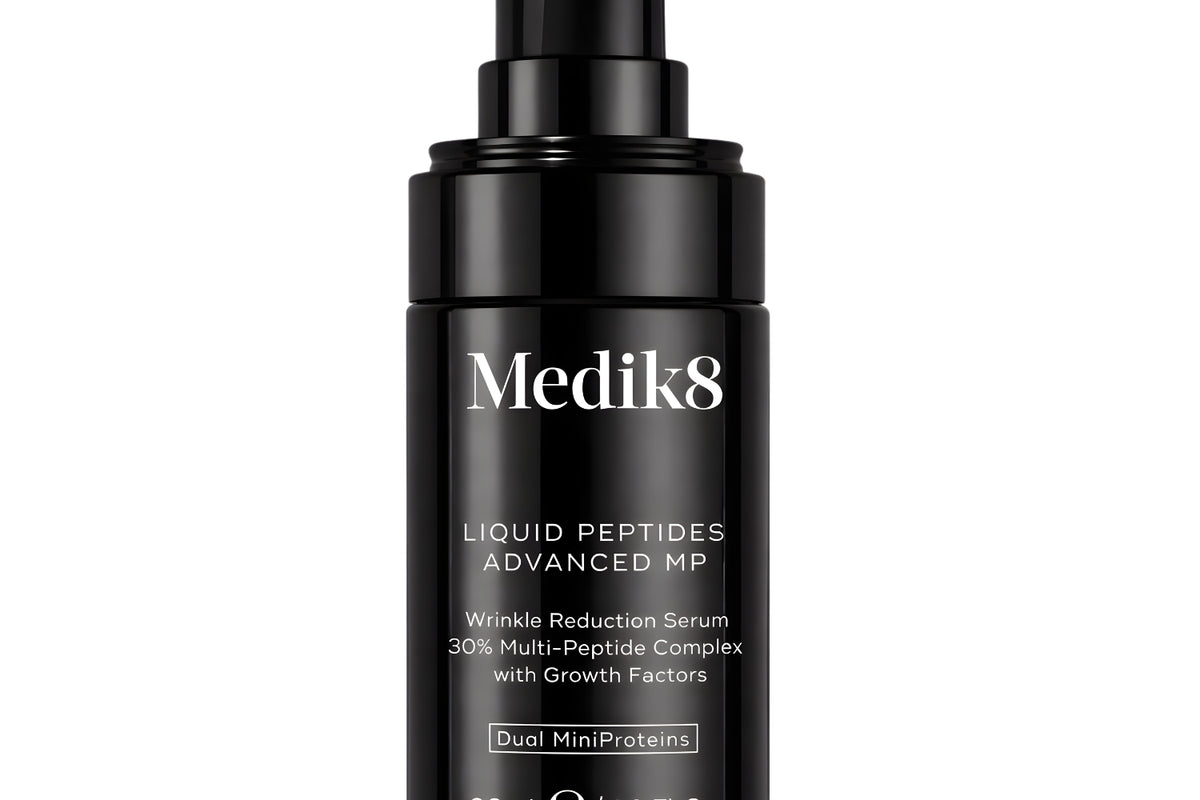
The modern classic, rebuilt. Thirteen peptides and hyaluronic acid are joined by Medik8's Dual MiniProteins, which target expression lines and firmness in tandem. Medik8's own clinical testing reports a softer look to expression lines within ten minutes and improvement in deeper wrinkles after eight weeks. Light, fast absorbing and easy to wear under makeup. Medik8 Liquid Peptides Advanced MP, €100
If expression lines are your focus:
Inspired by the science behind aesthetic medicine, this is the serum for the lines that come from a lifetime of frowning at your phone and laughing at your friends. A targeted peptide complex softens movement lines while 5% PHA, a gentle exfoliating acid, and 5% niacinamide refine texture and brighten. Clinically shown to reduce the look of nine types of expression line. SkinCeuticals P-Tiox, €150

If your skin needs repair:
The one for skin that has been through it, whether that is over exfoliation, hormonal shifts or simply a stressful season. Copper tripeptide supports collagen density while 2% ectoin, a molecule that shields cells from environmental stress, calms and strengthens. A striking blue serum with a weightless finish. Allies of Skin Copper Tripeptide and Ectoin Advanced Repair Serum, €221
If firmness and lift top your list:
A 9% lifting peptide complex meets a 3% growth factor complex, with copper lysinate and MSM supporting collagen. It is ophthalmologically approved, so you can take it right up to the eye contour. For skin that has started to lose its definition along the cheeks and jaw. Allies of Skin Multi Peptides and Growth Factors Advanced Lifting Serum, €199
If you want Korean skincare at an easy price:
From the Korean clinical brand Genosys, a concentrated serum with small molecule actives and peptides that encourage collagen production. Designed for skin from thirty onwards and gentle enough for sensitive types. The smartest entry point on this list. Genosys Multi Functioning Anti Wrinkle Serum, €48.50
For the eye area: Medik8 Eyelift Peptides
The skin around the eyes is thinner and shows change first. This serum uses peptides to target fine lines, puffiness and loss of firmness, with a light texture that sits well under concealer. Medik8 Eyelift Peptides, €60
Every SkinShop order comes with a free sample, delivery is free over €75 and first orders get 20% off when you subscribe. A good excuse to start your peptide era properly.
The takeaway
Peptides are not a trend and they are not a shortcut. They are one of the most tolerable, adaptable ingredients in evidence led skincare, with a clear job: helping your skin keep making the collagen it has always made. Choose a formula that matches your concern, use it every day and give it three months. Good skin has always been a long game. Peptides just help you play it well.
What do peptides do for skin?
Peptides act as messengers that encourage your skin to produce more collagen and elastin. Over time this helps skin look firmer and smoother, softens fine lines and supports a stronger skin barrier.
How long do peptides take to work?
Most people notice skin feeling more hydrated within two weeks. Visible changes in firmness and fine lines usually take eight to twelve weeks of daily use, as collagen renewal is a slow process.
Can I use peptides with retinol?
Yes, and they pair well. Retinol speeds up cell renewal while peptides support collagen through a different pathway and can help skin tolerate retinol more comfortably. Apply peptides first in the evening, or use them on nights you skip retinol.
Can I use copper peptides with vitamin C?
It is best to keep them apart. Use your vitamin C serum in the morning and copper peptides in the evening so both can work at their best.
Are peptides good for sensitive skin?
Generally, yes. Peptides are among the most gentle actives available and rarely cause irritation. Copper peptides in particular are often used to calm and strengthen stressed skin. As with any new product, patch test first.
What age should you start using peptides?
Your late twenties or early thirties is a good time to start, before collagen loss becomes visible. That said, it is never too late, and mature skin benefits just as much from consistent use.


